Trip.com × Design Consulting at Cornell • Fall 2026 • In progress
Designing Post-Booking Support Gen Z Can Trust
TIMELINE
Sep – Dec 2026
In progress
ROLE
Project Manager
Co-lead with Raina Ni
SCOPE
UX Research
Competitive Analysis
Design Strategy
TEAM
2 Project Managers
6 Design Consultants
TOOLS
Figma
FigJam
01 / OVERVIEW
Understanding how Gen Z experiences customer service, and turning it into a post-booking experience that builds trust and loyalty.
As one of two Project Managers, I’m co-leading a team of eight through a semester-long UX research and design project with Trip.com. The work has two connected parts: research into how Gen Z experiences customer service across digital platforms, including travel, e-commerce, delivery, and other everyday services, and UX design concepts for Trip.com’s post-booking experience. Research is underway, and design is in progress.
02 / CONTEXT
Booking is where the relationship starts, not where it ends.
Trip.com serves travelers worldwide across flights, hotels, trains, and more. For Gen Z, everything after checkout, from changes and disruptions to questions and support, keeps shaping whether they trust a travel platform.
Why it mattered
Gen Z expects fast, mobile-first self-service, but still wants a real person when something goes wrong. Post-booking support is where those expectations meet, and where loyalty is won or lost.

PROBLEM
How might we understand how Gen Z experiences customer service across digital platforms, and apply those insights to help Trip.com design a post-booking support experience that builds trust and loyalty?
OUR APPROACH
Research first, then design: learn how Gen Z experiences customer service everywhere, then turn those insights into concepts for Trip.com’s post-booking journey.
03 / PROCESS
How the work unfolded
01 LANDSCAPE
Literature review and competitive benchmarking.
Our 8 members reviewed 2 sources each, 16 in total, on Gen Z’s customer service expectations. Five themes kept recurring: post-booking as an ongoing journey, speed and control, the AI–human split, proactive support, and post-booking engagement.
We then benchmarked 8 platforms, including Expedia, Booking.com, Google Flights, Klook, Hopper, and two major airlines, across help centers, AI chat, human agents, and call options. Hopper ranked highest for its capable AI agent; most others gated support behind login or booking selection.

02 USER RESEARCH
48 interviews with Gen Z travelers.
Each of our 8 members ran 6 interviews: 48 in total, with 33 US students and 15 international students. We asked how Gen Z finds, plans, and books trips, what their post-booking experience is like, what makes support feel good or frustrating, and how they perceive Trip.com.
Early impressions:
• They search on third-party platforms, then book directly with the airline.
• They distrust chatbots, especially when the bot can’t act.
• Booking confirmations get buried; they want reliable updates.
• Bundles appeal for unfamiliar trips, not routine ones.

03 DESIGN · IN PROGRESS
Synthesis and ideation, happening now.
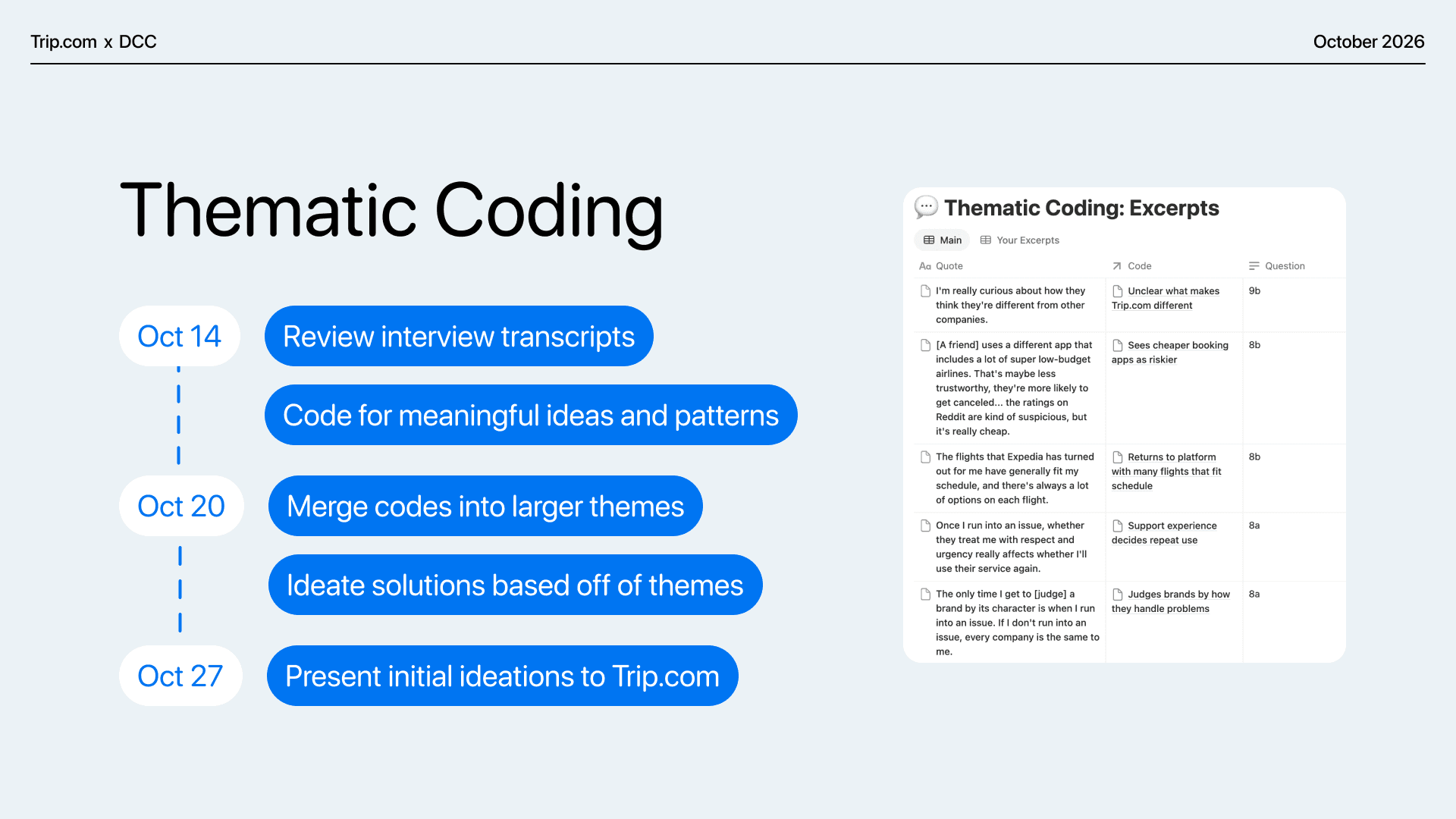
We’re coding interview transcripts and merging codes into larger themes, then ideating solutions to present to Trip.com.
Next come Gen Z traveler personas, a post-booking journey map, prioritized opportunity areas, and low-fidelity wireframes, followed by usability testing and high-fidelity prototypes.
To be continued.
04 / KEY INSIGHTS
Four insights guiding our design
01 Post-booking is a product journey
Treat post-booking as a core product experience, not a place users go only when something breaks.
02 AI for speed, humans for stakes
Let AI handle quick questions and status, and people handle complexity and money, with easy transfer between the two.
03 Escalate before they ask
Detect AI failure or urgency and surface a human agent, or escalate automatically.
04 Tell travelers what’s happening
Move from reactive support to proactive updates: what changed, your options, take action.
05 / DESIGN · IN PROGRESS
Design is in progress. To be continued.
We’re translating research into design directions now. This section will be updated as concepts, testing, and prototypes come together.
Up next · Personas, journey map & opportunity areas
Gen Z traveler personas, a post-booking customer service journey map, 2–3 prioritized opportunity areas, and low-fidelity wireframes.
In progress: personas, journey map & wireframes
Then · Usability testing, iteration & handoff
Concepts tested with Gen Z participants and iterated into high-fidelity prototypes, then a research report, prototypes, and design recommendations handed off to the client.
To be continued: usability testing & high-fidelity prototypes
06 / PROGRESS SO FAR
Where the project stands
16
Sources reviewed on Gen Z customer service
8
Travel platforms benchmarked
48
Gen Z interviews conducted
Upcoming milestones: mid-semester presentation, usability testing, the DCC final showcase, and client handoff in December.
07 / LEARNINGS SO FAR
What I’m learning as a project manager
Shared structure lets research scale.
Giving every member the same scope, 2 sources and 6 interviews each, let eight people cover 16 sources and 48 interviews with findings that still fit together.
Competitors’ gaps are the opportunity.
Across eight platforms, support was gated, buried, or handed off without context, which points to clear ways a post-booking experience can stand out.
Client syncs keep research actionable.
Presenting to the client every few weeks pushes us to turn findings into takeaways they can act on, not just observations.
To be continued
This case study is a work in progress. Final designs, testing results, and outcomes will be added after the December showcase.
Have an idea or a question about this project?